TABLE OF CONTENTS
Housekeeping Connector Overview
The Housekeeping connector in ManagementStudio provides automated tools to remove obsolete data, helping keep your environment optimised and ensuring smooth system operation. Housekeeping functionality is organised into separate panels, each responsible for a specific data area:
- Housekeeping Status
- User Housekeeping
- Device Housekeeping
- Test Sign-Off Housekeeping
- Intune Housekeeping
- General Links Housekeeping
- Miscellaneous Tasks
Administrators can toggle each panel on or off as required.
Housekeeping Status
This panel controls the scheduling and execution of Housekeeping tasks. The following table describes each UI element:
| UI Element | Description |
|---|---|
Run Housekeeping Now | Run all enabled Housekeeping tasks immediately. |
Schedule Housekeeping Discovery #1 | Specify when to run the first scheduled Housekeeping Discovery. See scheduled tasks article for more information. |
Schedule Housekeeping Discovery #2 | Specify when to run the second scheduled Housekeeping Discovery. Refer to the same article above. |
Last Run Date | Shows the date and time the last Housekeeping run completed successfully. |
Housekeeping log | Displays logs generated during Housekeeping runs. |
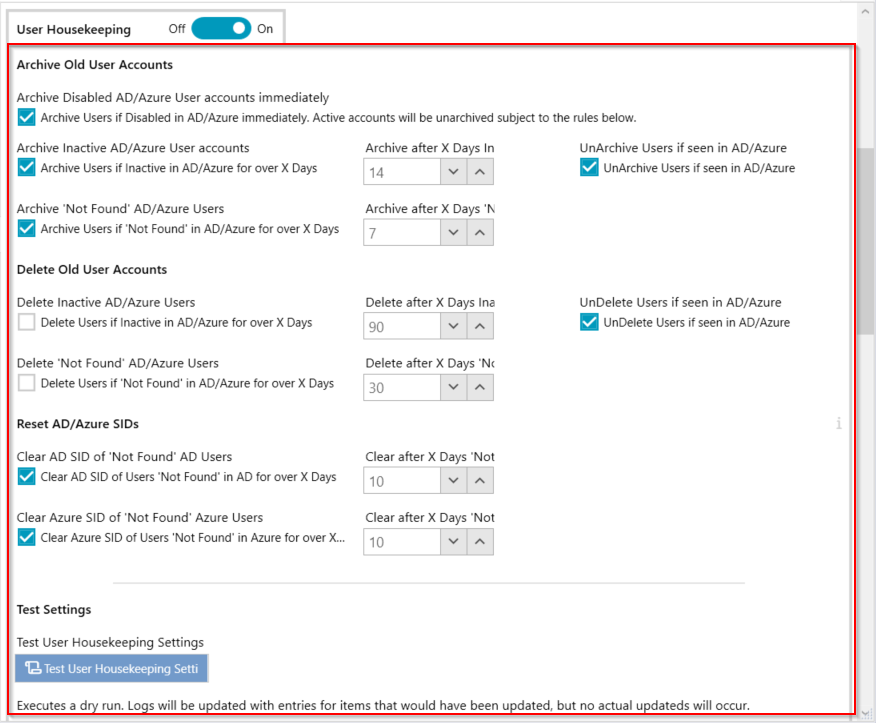
User Housekeeping
Manage archiving, deletion, and SID reset of user accounts based on Active Directory (AD) or Azure AD status.
| UI Element | Description |
|---|---|
Archive Old User Accounts | Enable archiving operations for user accounts. |
Archive Disabled AD/Azure User accounts immediately | Archive users disabled in AD/Azure immediately. |
Archive Inactive AD/Azure User Accounts | Archive users inactive in AD/Azure for over a specified number of days. |
Archive after X Days Inactive | Set the inactivity threshold (in days) for archiving. |
UnArchive Users if seen in AD/Azure | Unarchive users if detected as active in AD/Azure. |
Archive 'Not Found' AD/Azure Users | Archive users not found in AD/Azure for more than a specified number of days. |
Archive after X Days 'Not Found' | Set the not-found threshold (in days) for archiving. |
Delete Old User Account | Enable deletion operations for user accounts. |
Delete Inactive AD/Azure Users | Delete users inactive in AD/Azure for over a specified number of days. |
Delete after X Days Inactive | Set the inactivity threshold (in days) for deletion. |
UnDelete Users if seen in AD/Azure | Restore deleted users if detected as active in AD/Azure. |
Delete 'Not Found' AD/Azure Users | Delete users not found in AD/Azure for more than a specified number of days. |
Delete after X Days 'Not Found' | Set the not-found threshold (in days) for deletion. |
Reset AD/Azure SIDs | Enable SID reset operations. |
Clear AD SID of 'Not Found' AD Users | Clear AD SIDs for users not found in AD for over a specified number of days. |
Clear after X Days 'Not Found' | Set the not-found threshold (in days) for SID clearing (AD or Azure as appropriate). |
Clear Azure SID of 'Not Found' Azure users | Clear Azure SIDs for users not found in Azure for over a specified number of days. |
Clear after X days 'Not Found' | Set the not-found threshold (in days) for Azure SID clearing. |
Test Settings | |
Test User Housekeeping Settings | Perform a dry run—logs entries for items that would be affected, but no changes are made. |
Device Housekeeping
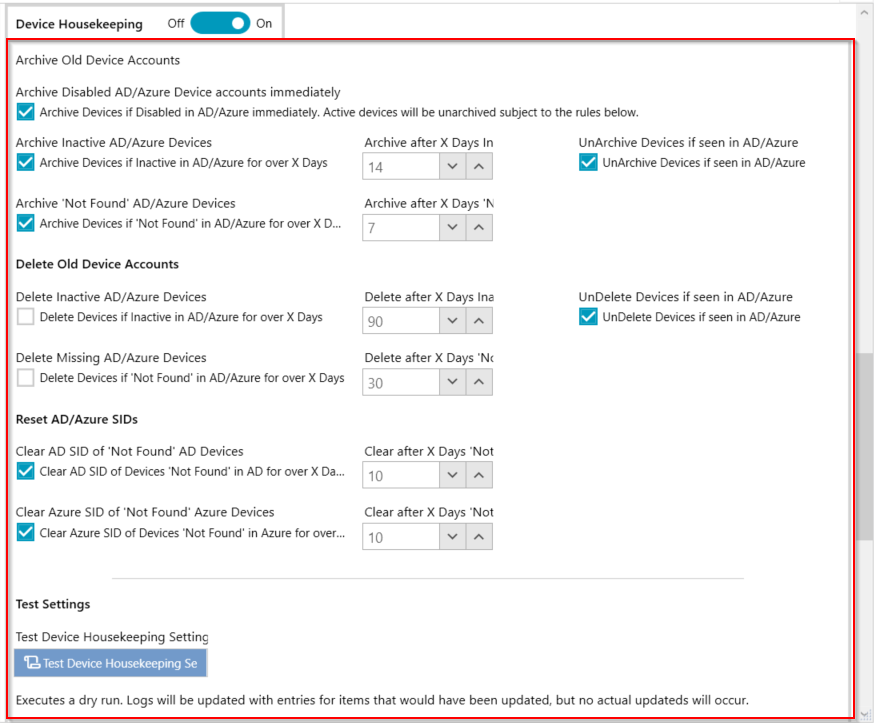
Manage the lifecycle of device accounts by archiving, deleting, and resetting SIDs, based on AD or Azure AD status.
| UI Element | Description |
|---|---|
Archive Old Device Accounts | Enable archiving for device accounts. |
Archive Disabled AD/Azure Device accounts immediately | Archive devices disabled in AD/Azure immediately. Active devices are unarchived as per rules below. |
Archive Inactive AD/Azure Devices | Archive devices inactive in AD/Azure for over a specified number of days. |
Archive after X Days Inactive | Set inactivity threshold (in days) for archiving. |
UnArchive Devices if seen in AD/Azure | Unarchive device if detected as active in AD/Azure. |
Archive 'Not Found' AD/Azure Devices | Archive devices not found in AD/Azure for more than a specified number of days. |
Archive after X Days 'Not Found' | Set the not-found threshold (in days) for archiving. |
Delete Old Device Accounts | Enable deletion of device accounts. |
Delete Inactive AD/Azure Devices | Delete devices inactive in AD/Azure for over a specified number of days. |
Delete after X Days Inactive | Set inactivity threshold (in days) for deletion. |
UnDelete Users if seen in AD/Azure | Restore deleted device if detected as active in AD/Azure. |
Delete Missing AD/Azure Devices | Delete devices not found in AD/Azure for over a specified number of days. |
Delete after X Days 'Not Found' | Set the not-found threshold (in days) for device deletion. |
Reset AD/Azure SIDs | Enable SID reset operations. |
Clear AD SID of 'Not Found' AD Devices | Clear AD SIDs for devices not found in AD for over a specified number of days. |
Clear after X Days 'Not Found' | Set the not-found threshold (in days) for SID clearing (AD or Azure as appropriate). |
Clear Azure SID of 'Not Found' Azure Devices | Clear Azure SIDs for devices not found in Azure for over a specified number of days. |
Clear after X days 'Not Found' | Set the not-found threshold (in days) for Azure SID clearing. |
Test Settings | |
Test Device Housekeeping Settings | Perform a dry run—logs entries for items that would be affected, but no changes are made. |
Test Sign-Off Housekeeping
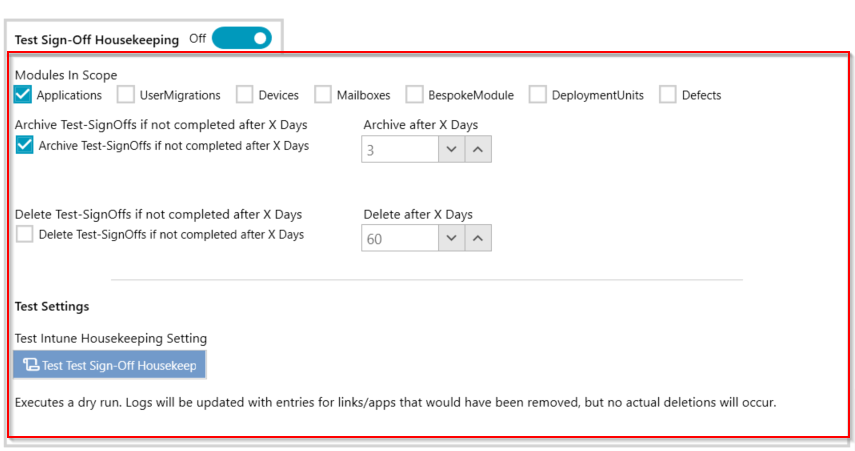
Automate the clean-up of incomplete or aged Test Sign-Offs.
| UI Element | Description |
|---|---|
Modules in Scope | Select modules in scope for Test Sign-Off housekeeping. |
Archive Test-Sign-Offs if not completed after X days | Archive incomplete Test Sign-Offs older than specified days. |
Archive after X Days | Set the threshold (in days) for archiving incomplete Test Sign-Offs. |
Delete Test Sign-Offs if not completed after X Days | Delete incomplete Test Sign-Offs older than specified days. |
Delete after X Days | Set the threshold (in days) for deleting incomplete Test Sign-Offs. |
Test Settings | |
Test Sign-Off Housekeeping Settings | Perform a dry run—logs entries for items that would be affected, but no changes are made. |
Intune Housekeeping
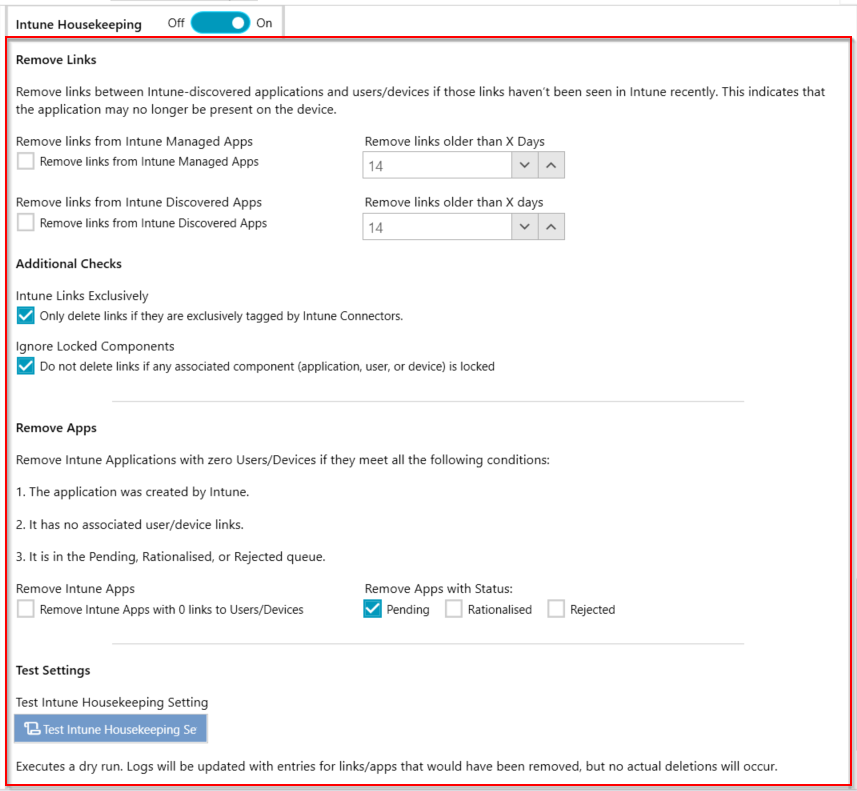
Configure removal of obsolete Intune-related data, including links and unused applications.
| UI Element | Description |
|---|---|
Remove Links | Remove links between Intune-discovered applications and users/devices if those links are not seen recently. |
Remove links from Intune Managed Apps | Remove links from Intune Managed Apps based on age. |
Remove links older than X Days | Set the threshold (in days) for removing links from Intune Managed Apps. |
Remove links from Intune Discovered Apps | Remove links from Intune Discovered Apps based on age. |
Remove Links older than X Days | Set the threshold (in days) for removing links from Intune Discovered Apps. |
Additional Checks | Additional filters and constraints for link/app removal. |
Intune Links Exclusively | Only delete links if they are exclusively tagged by Intune Connectors. |
Ignore Locked Components | Prevent deletion if any associated component (application, user, device) is locked. |
Remove Apps | |
Remove Intune Applications with zero Users/Devices if they meet all the following conditions: | Apps must: 1) Be created by Intune, 2) Have no user/device links, 3) Be in the pending, Rationalised, or Rejected queue. |
Remove Intune Apps | Remove Intune apps with zero links to users or devices. |
Remove Apps with Status | Specify application statuses for removal. |
Test Settings | |
Test Intune Housekeeping Setting | Perform a dry run—logs entries for items that would be affected, but no changes are made. |
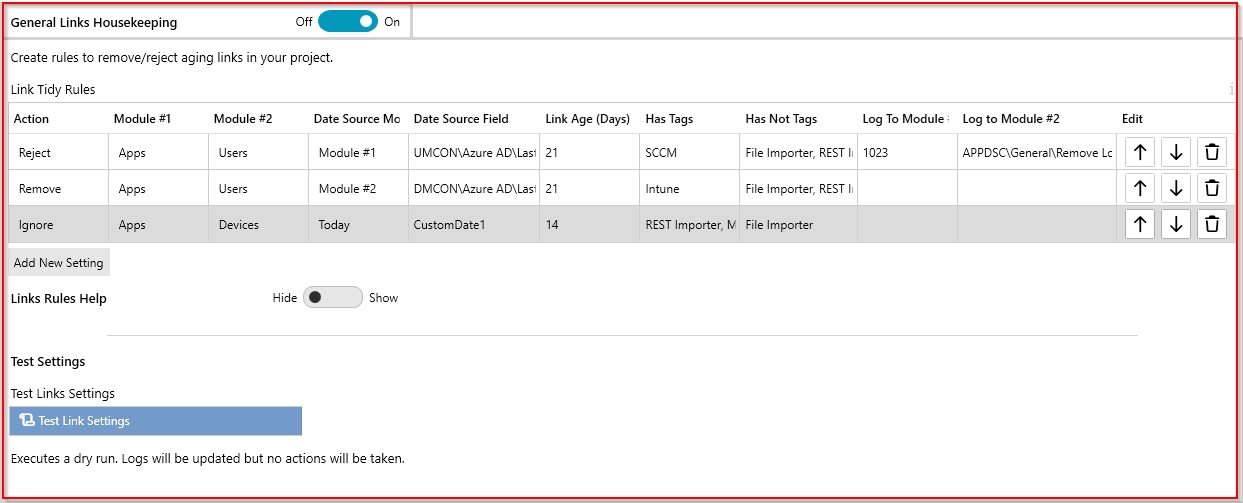
General Links Housekeeping
Configure removal of outdated links data in your project.
UI Element | Description |
| Link Tidy Rules Settings | |
| Action |
|
| Module #1/Module #2 |
|
| Module #2 Matching |
|
| Data Source Module |
|
| Data Source Field |
|
| Link Age (Days) |
|
| Has Tags |
|
| Has Not Tags |
|
| Log to Module #1 / Module #2 |
|
Test Settings | |
| Test Link Settings | Perform a dry run—logs entries for items that would be affected, but no changes are made. |
Examples
- Remove all User → Applinks from SCCM that are more than 90 days old, regardless of whether the links include device information.
- Remove, User, App*, Today, LastUsedDate, 90, SCCM

- Remove all User → Applinks associated with users who last logged in more than six months ago.
- Remove, User, App*, Module #1, UMCON\AD\Last Logon, 180

Miscellaneous Tasks
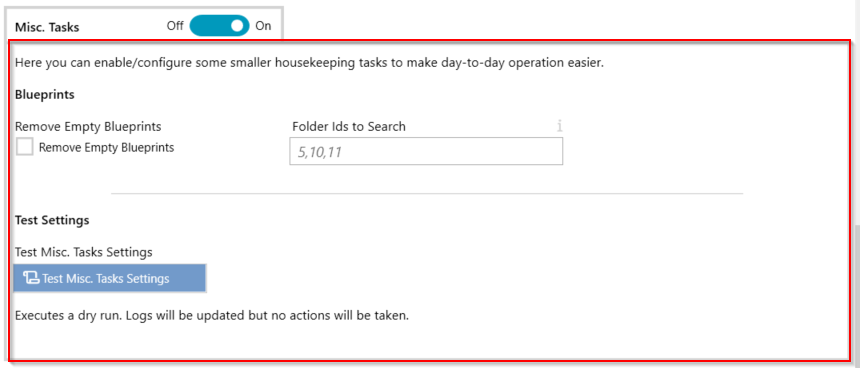
Configure supplemental housekeeping operations for blueprints and related items.
| UI Element | Description |
|---|---|
Blueprints | |
Remove Empty Blueprints | Remove blueprints with no content. |
Folder Ids to Search | Comma-separated list of folder IDs to search for empty blueprints (includes subfolders). Enter 0 to search all blueprint folders. E.g. 5,6,8 |
Test Settings | |
Test Misc. Tasks Settings | Perform a dry run—logs entries for items that would be affected, but no changes are made. |
Configuring the Housekeeping Extension
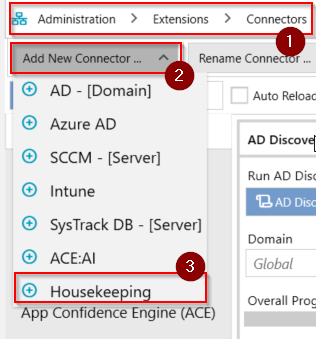
- Navigate to
Administration → Extensions → Connectors. - Click
Add New Connector. - Select
+ Housekeeping.
- The Housekeeping panel will appear in the left tabbed menu.
- Use the toggle buttons to enable the sections you wish to configure.
- Click
Save Changesonce setup is complete.
To run Housekeeping:
- Click
Run Housekeeping Now. - Click
Continue. - After a few minutes, click
Reload. - The
Housekeeping Logshould now display details of the run.
To schedule Housekeeping runs:
Please refer to the Scheduling the Housekeeping connector article.
Further Support
For further assistance, visit the ManagementStudio Service Desk to search the knowledge base or submit a support ticket.
Was this article helpful?
That’s Great!
Thank you for your feedback
Sorry! We couldn't be helpful
Thank you for your feedback
Feedback sent
We appreciate your effort and will try to fix the article