TABLE OF CONTENTS
- Introduction
- Step 1 – Enable Meeting Request
- Step 2 – Send User Booking Link
- Embedding Custom iCal Meeting Requests in emails
- Further Support
Introduction
iCal is a computer file format for storing calendar information. It is short for iCalendar. It is designed to be an open standard to allow for easy interoperability with many different applications, ManagementStudio being one of those. The iCal feature is configurable within the Test Sign-Offs and Self-Scheduling components.
This guide will walk through the steps required to send a self-schedule booking appointment with the iCal information attached.
It is assumed a deployment unit, deployment schedule has been configured and Users have been added into the deployment unit.
Step 1 – Enable Meeting Request
- Switch to Administration -> User Migrations -> DeployUnit & Self-Schedule (1).
- Ensure the Deployment Units for UserMigrations is Enabled (2).
- Click on the Settings (3) tab.
- Scroll down to the Meeting Request panel (4). Use this panel to control & customize the meeting invitations sent out to the end users.
- Attach Meeting Request to Email: When this option is enabled, it will attach an iCal (Meeting Request) file to the 'Complete' email.
- Outlook Reminder (Min): Specify the number of minutes before the appointment. This will allow Outlook to popup a reminder.
- Appointment Subject: Specify a clear appointment subject line.
- Appointment Location: Provide a location of the appointment. Deployment Unit location keywords can be used. Here is a list of available keywords.
- Appointment Description: Provide a brief description of the appointment.
Please note, keywords can be used within the Appointment location & Description textboxes. The description textbox has a limit of 1000 length characters.
- Click Save Changes (5) to commit the changes.

Step 2 – Send User Booking Link
- When a User is sent the booking link to book their migration slot.
- Upon submitting their booking, they will receive a Complete Email with the iCal file enclosed.
- Clicking on the attached iCal file will automatically add the appointment to their diary in Outlook.
- The screenshot below shows an example of the iCal file.

Embedding Custom iCal Meeting Requests in emails
You can embed custom meeting invites directly within an email template by using a specific format. This feature enables you to define meeting details—such as start and end times—through keyword-based placeholders.
To include a meeting invite, insert the following block anywhere in the email body. The content must be enclosed within <# and #> tags:
<#
    #InviteIcs#
    Summary: My Meeting Subject
    StartDate: [UM-DeployUnitSlotStart-f{u}]
    EndDate: [UM-DeployUnitSlotEnd-f{u}]
    UseUtcOffSet: false
    UtcOffSet: 0
    ReminderMin: 15
    Location: My Location
    Description: Invite Description
    HtmlDescription: <b>Invite</b> <i>Description</i>
#>
Dates
When using Date Keywords ( e.g. [UM-DeployUnitSlotStart-f{u}] ). It is required that you include the -f{u} option to format these dates in universal time.
Required Fields:
#InviteIcs#SummaryStartDate
If any of these are missing, the invite will not be generated. All other fields are optional and may be omitted.
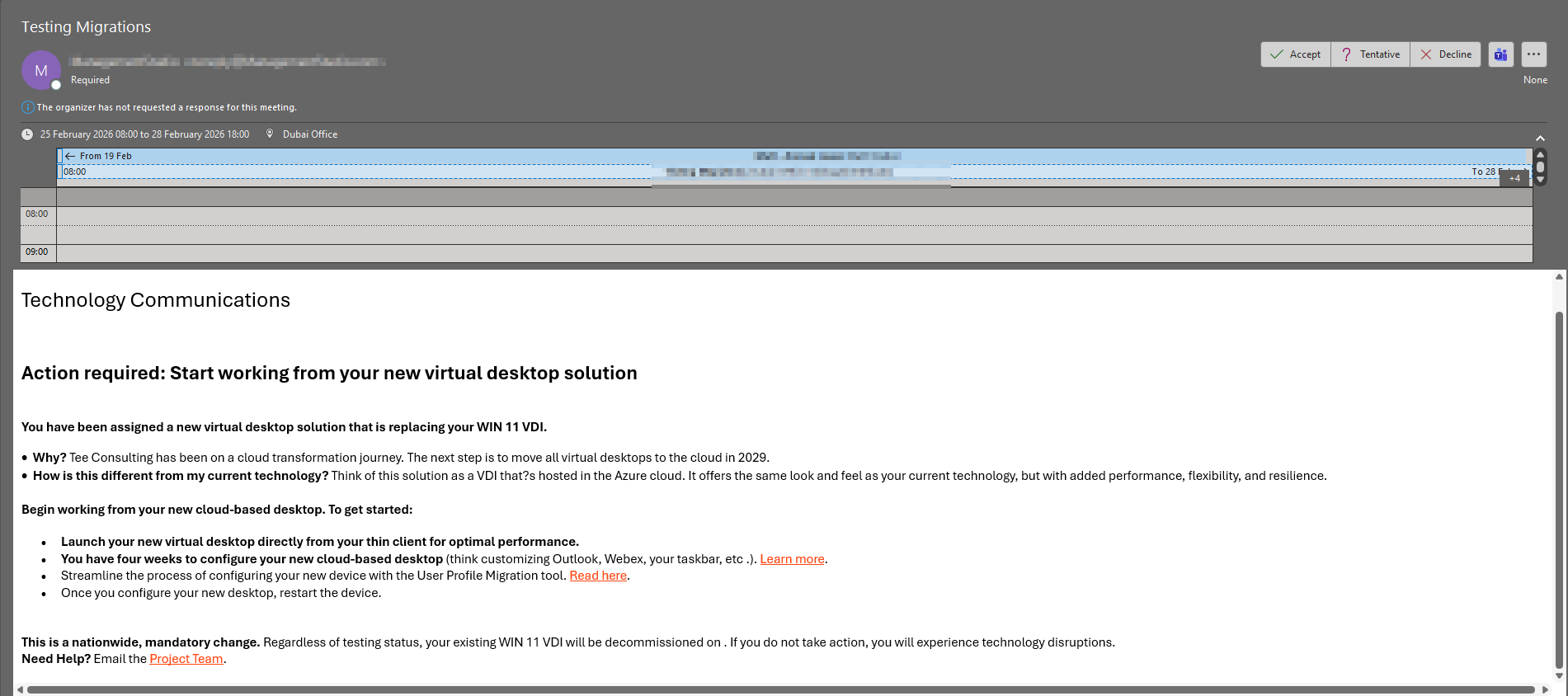
Example
<#
    #InviteIcs#
    Summary: Testing Migrations
    StartDate: [UM-CustomForm-5453-f{u}]
    EndDate: [UM-CustomForm-5454-f{u}-t{+1}]
    UseUtcOffSet: false
    UtcOffSet: 0
    ReminderMin: 15
    Location: Dubai Office
    Description: Migration Slots
     HtmlDescription:
<p style="font-size: 26px;">Technology Communications</p></b><br><b><p style="font-size: 24px;">Action required: Start working from your new virtual desktop solution</p></b> <br>
<b>You have been assigned a new virtual desktop solution that is replacing your WIN 11 VDI. </b><br>

<li><b>Why?</b> Tee Consulting has been on a cloud transformation journey. The next step is to move all virtual desktops to the cloud in 2029.</li>
<li><b>How is this different from my current technology?</b> Think of this solution as a VDI that’s hosted in the Azure cloud. It offers the same look and feel as your current technology, but with added performance, flexibility, and resilience. </li>


<b>Begin working from your new cloud-based desktop. To get started: </b>

<ul>
<li><b>Launch your new virtual desktop directly from your thin client for optimal performance. </b></li>
<li><b>You have four weeks to configure your new cloud-based desktop</b> (think customizing Outlook, Webex, your taskbar, etc .). <a href="https://myproject.com" style="color: #FF4713; text-decoration: underline;"> Learn more</a>.</li>
<li>Streamline the process of configuring your new device with the User Profile Migration tool. <a href="https://myprojectresource.com" style="color: #FF4713; text-decoration: underline;"> Read here</a>.</li>
<li>Once you configure your new desktop, restart the device.</li>
</ul>

<b>This is a nationwide, mandatory change.</b> Regardless of testing status, your existing WIN 11 VDI will be decommissioned on </b>. If you do not take action, you will experience technology disruptions.

<b>Need Help?</b> Email the <a href="mailto:myprojectmailboxhelpdesk.com?subject=Windows%2011%20issue" style="color: #FF4713; text-decoration: underline;">Project Team</a>.


#>
Corresponding ical file attached to the email sent.
Further Support
If you require further support, please visit ManagementStudio's Service Desk to search the knowledge base or create a new support ticket.
Was this article helpful?
That’s Great!
Thank you for your feedback
Sorry! We couldn't be helpful
Thank you for your feedback
Feedback sent
We appreciate your effort and will try to fix the article